5 Signs the Infrastructure Around Your Equipment May Be Holding Production Back
Production lines rarely stay exactly as they were originally designed. Equipment gets replaced. New machines are added. Conveyors are rerouted. Production speeds increase. Product formats change. Maintenance requirements evolve. What started as a carefully planned production area can gradually become a very different operation.
But while the production line changes, the infrastructure surrounding it may not.
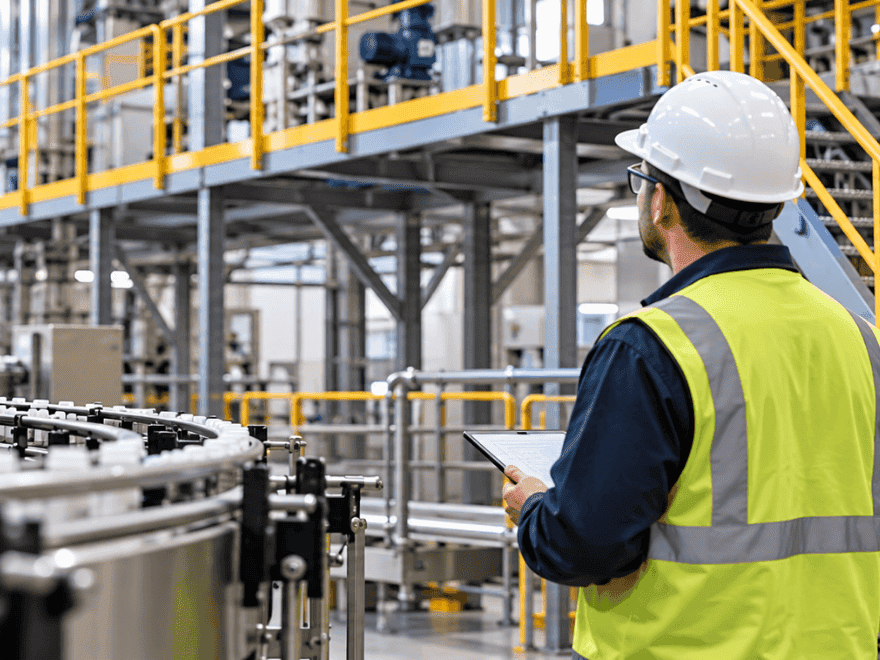
Platforms, stairs, crossovers, equipment supports, access points and other structural elements may have been designed around equipment and workflows that no longer exist. Over time, that disconnect can make maintenance more difficult, restrict movement around equipment and create inefficiencies that aren’t immediately traced back to the facility itself.
The equipment may be doing its job. The question is whether everything around it is still supporting the way your operation works today. Here are five signs it’s worth taking a closer look.
1. Maintenance Access Has Become More Difficult
Maintenance requirements should be part of how the space around production equipment functions. But when equipment is added, replaced or repositioned over time, access that once worked well can become restricted. Technicians may have less room to inspect components, remove parts or perform routine service.
Consider what happens during a typical maintenance task. Can technicians reach the components they need to inspect? Is there enough clearance to remove and replace larger components? Can maintenance work be completed without unnecessarily disrupting adjacent equipment or production areas?
If routine maintenance increasingly requires workarounds, extra disassembly or additional downtime simply to reach the equipment, the problem may not be the machine. It may be the infrastructure surrounding it.
Platforms, stairs, access points and equipment positioning can sometimes be modified to better support how the equipment is actually maintained today.
2. Operators Are Working Around the Layout Instead of With It
One of the clearest signs that a production area has evolved beyond its original design is the number of workarounds that have become part of everyday operations.
Operators may take longer routes around equipment. Materials may move through spaces that weren’t originally intended for product flow. Access to controls or production areas may be less direct because newer equipment occupies space that was once open.
Individually, these compromises may seem minor. Over hundreds of production cycles, they can become part of how the facility operates without anyone questioning why.
Look at how people and materials actually move through the area—not how they were expected to move when the line was originally configured. If employees consistently have to adapt to the layout, it may be time for the layout to adapt to them.
3. Platforms, Stairs and Crossovers No Longer Match the Operation
Platforms and crossovers serve a practical purpose: providing access and movement around production equipment while supporting the needs of the operation.
But a platform designed around one machine configuration may not provide the same functionality after equipment is replaced or a line is expanded.
A new conveyor could change where employees need to cross the line. A taller piece of equipment could change service access. Additional machinery could make an existing stair location less practical. Production changes could create a need for access to areas that weren’t previously serviced regularly.
Instead of treating these structures as permanent simply because they already exist, manufacturers should periodically ask whether they still support the current operation. In some cases, modifying or fabricating platforms, stairs, crossovers or related structures can make the production area better suited to the equipment and workflows now in place.
4. Equipment Changes Have Created New Support Requirements
Replacing a machine isn’t always a one-for-one change. New equipment can have different dimensions, weights, elevations, connection points and operating characteristics. Those differences can affect more than where the machine sits.
Machine bases, structural supports and surrounding fabricated components may need to accommodate equipment that wasn’t part of the facility’s original configuration.
The same applies when production lines are modified incrementally. One change may be relatively simple. Several changes over a period of years can create a collection of modifications that were each addressed individually rather than as part of a larger system.
When equipment is being replaced, relocated or upgraded, it’s worth evaluating whether the existing support infrastructure is still appropriate for what is being asked of it.
5. No One Has Looked at the Entire Production Area in Years
This may be the most important sign of all. Plants are constantly solving immediate problems. A machine needs to be replaced. A conveyor needs to move. A platform needs to be modified. Capacity needs to increase. Each project gets completed, and production continues.
But after years of individual changes, when was the last time someone evaluated the entire production area as it operates today?
A broader review can reveal issues that aren’t obvious when equipment and infrastructure are evaluated one project at a time.
Are maintenance areas still accessible? Do operators have practical routes through the facility? Are platforms and crossovers located where they’re actually needed? Are machine supports appropriate for current equipment? Could a relatively small facility modification eliminate a workaround that has existed for years?
The goal isn’t to redesign a production area simply because it has changed. It’s to identify whether the accumulation of those changes is now affecting how efficiently the space supports production.
Look Beyond the Equipment
When manufacturers think about improving production, attention naturally goes to the machinery. Sometimes that’s exactly where the problem is.
But if equipment has changed substantially while the surrounding facility has remained largely the same, improving the infrastructure around the line may be another opportunity worth evaluating.
Incline Industrial Services works with manufacturers on millwright services, custom fabrication, equipment installation and integration, and the platforms, stairs, crossovers, machine bases and support structures required around production equipment. By looking at how equipment, people and infrastructure work together, facility modifications can be planned around the realities of the operation—not simply the way the production area was originally configured.
Has your production line changed while the facility around it stayed the same? Talk with Incline Industrial Services about evaluating the infrastructure supporting your operation.
Serving the Food, Beverage & Chemical Processing Industries.