In many production environments, bottlenecks are often attributed to process flow, capacity limits, or operator variability. These are visible and easy to measure. But in practice, the cause is frequently more mechanical than operational.
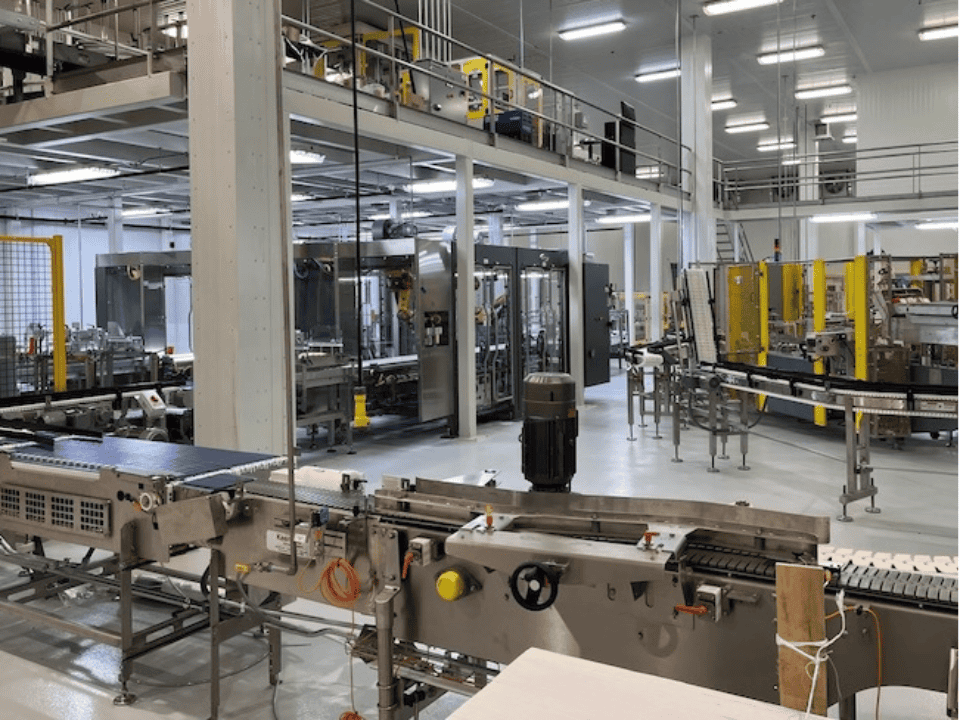
Even well-designed production lines can experience slowdowns when equipment doesn’t interact as intended. These issues are not always obvious at startup, and they rarely originate from a single point. Instead, they develop within the physical connections between systems—where alignment, integration, and real-world conditions begin to influence performance.
Bottlenecks Often Develop Between Systems, Not Within Them
When production slows, the focus is often placed on individual pieces of equipment. However, bottlenecks are just as likely to form at the transition points between machines.
This is where product moves from one system to another, where elevation changes occur, and where alignment must be exact. If these transitions are even slightly off, product flow can become inconsistent. Material may hesitate, shift, or accumulate in ways that disrupt the pace of the line.
These are not always design flaws. In many cases, they are the result of how systems are installed and integrated in the field.
Alignment Influences Flow More Than It Appears
Mechanical alignment affects more than just equipment stability; it directly influences how product moves through the system.
Even minor misalignment between conveyors or connected systems can introduce resistance. Over time, this can lead to uneven loading, inconsistent flow, and increased stress on components. These issues rarely stop production outright, but they reduce throughput and contribute to ongoing inefficiencies.
When alignment is correct, systems function as a continuous process rather than a series of disconnected components.
Transfer Points Are Where Bottlenecks Take Shape
Transfer points represent one of the most sensitive areas in any production line. One system must feed another precisely, at the right speed, position, and orientation.
When that interaction is off, even slightly, the effects can compound quickly. Product may not transfer cleanly, downstream systems may adjust to compensate, and operators may intervene to maintain flow. Over time, these adjustments become part of daily operation, masking the underlying issue while limiting overall performance.
Small Mechanical Issues Become System Constraints
Production lines operate as interconnected systems. A small inefficiency at one point—whether related to alignment, transfer, or structural support, can influence the entire operation.
What begins as a minor disruption can:
- Reduce overall throughput
- Increase cycle time
- Create recurring intervention points
- Accelerate wear on key components
Because these issues develop gradually, they are often accepted as normal rather than addressed at the source.
Identifying the Source of Bottlenecks
Bottlenecks are not always the result of process limitations or insufficient capacity. In many cases, they originate from how equipment is installed, aligned, and integrated within the system.
Recognizing these mechanical influences is key to improving performance. When transitions are properly aligned and systems work together as intended, product flow stabilizes and overall efficiency improves.
Why It Matters for Overall Line Performance
A production line doesn’t need to stop to signal a problem. It only needs to slow down.
When that happens, the cause is often found in the mechanics of the system, where equipment connects, interacts, and moves product forward.
Understanding those points, and how they influence performance, can make the difference between a line that simply runs and one that operates at its full potential. When alignment is correct, systems function as a continuous process rather than a series of disconnected components, which highlights how users navigating a structured digital environment.
Experiencing bottlenecks or inconsistent product flow? Incline Industrial Services works with plant teams to evaluate mechanical alignment, system interaction, and execution factors that impact performance, helping identify where issues originate and how to correct them.